Beneath the Skin: Interactive Biomechanical Facial Simulations via Composable Co-Expressions
2Augmenta, United States
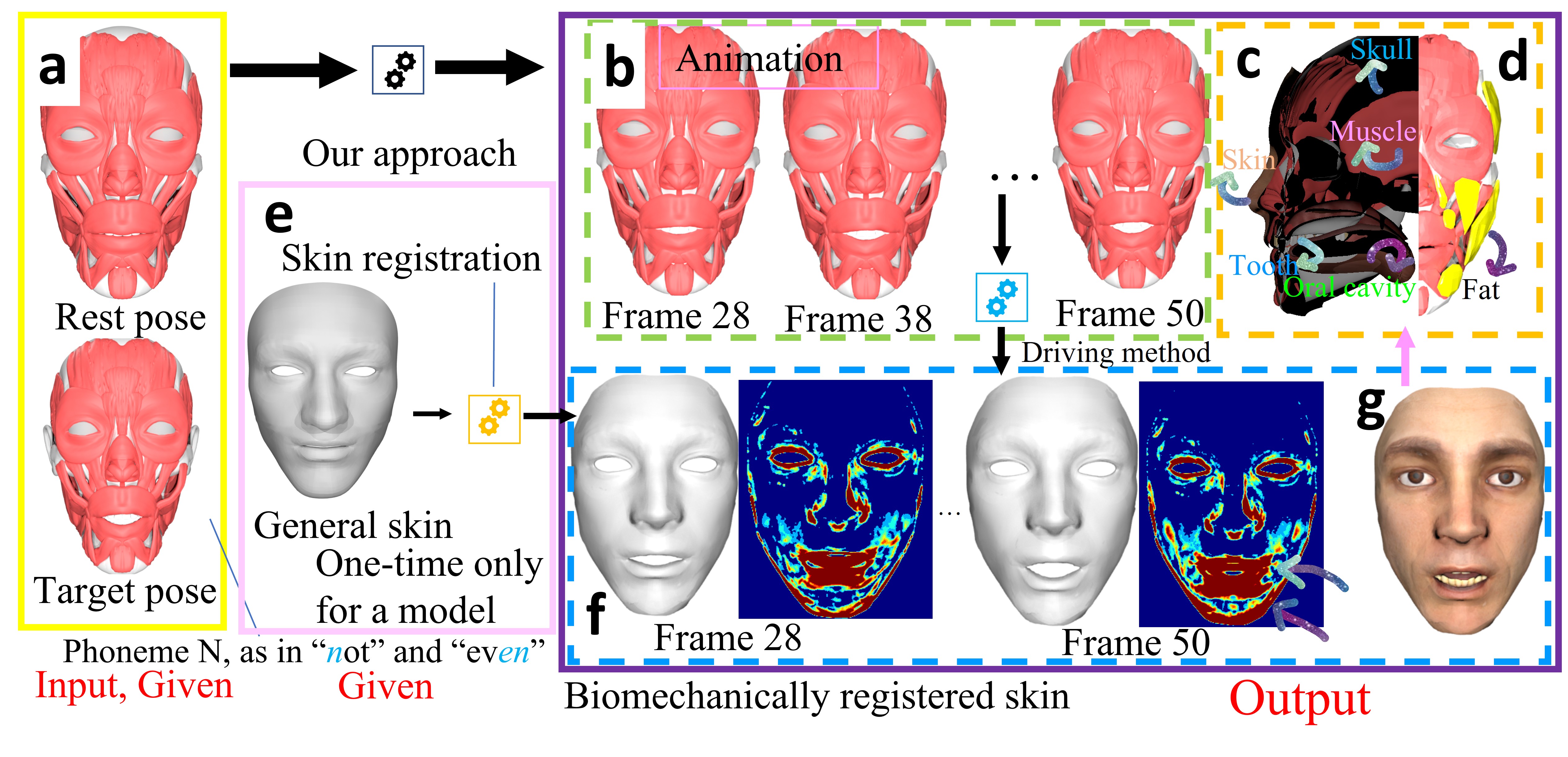
Realistic facial animation plays a pivotal role in animating convincing, expressive characters. While kinematic techniques offer great artistic engagement, and motion capture offers explicit human performances, biomechanical simulation promises physical plausibility that respects volume preservation, passive dynamics, momentum, deformation, and gravity. However, physical approaches have often come at the price of reduced artistic engagement due to the mismatch between the complexity and constraints of biomechanical motion synthesis and the expressive flexibility demanded by artists. We provide a partial resolution to this tension through a biomechanical musculoskeletal facial model that is bridged to expressive animation through the generation of physical motor controllers that interpolate facial configurations and action units, including speech. We chose the FACS model [Ekman et al. 1978] that is commonly used by character animators, although motions, i.e., muscle activation sequences, can be synthesized for any set of physically plausible facial poses. These controllers may then be composed into complex, realistic motion sequences. Furthermore, the optimal simulation of these sequences requires muscle activation co-expression in a manner that is consistent with coarticulation in speech synthesis. While our primary goal is to demonstrate ``under the skin'' motion synthesis, we describe a skinning technique that attaches to our musculoskeletal model to demonstrate the potential of fully biomechanical, expressive, artist-directable facial animation.