Zhiyun (Richard) Peng 彭志云
About me
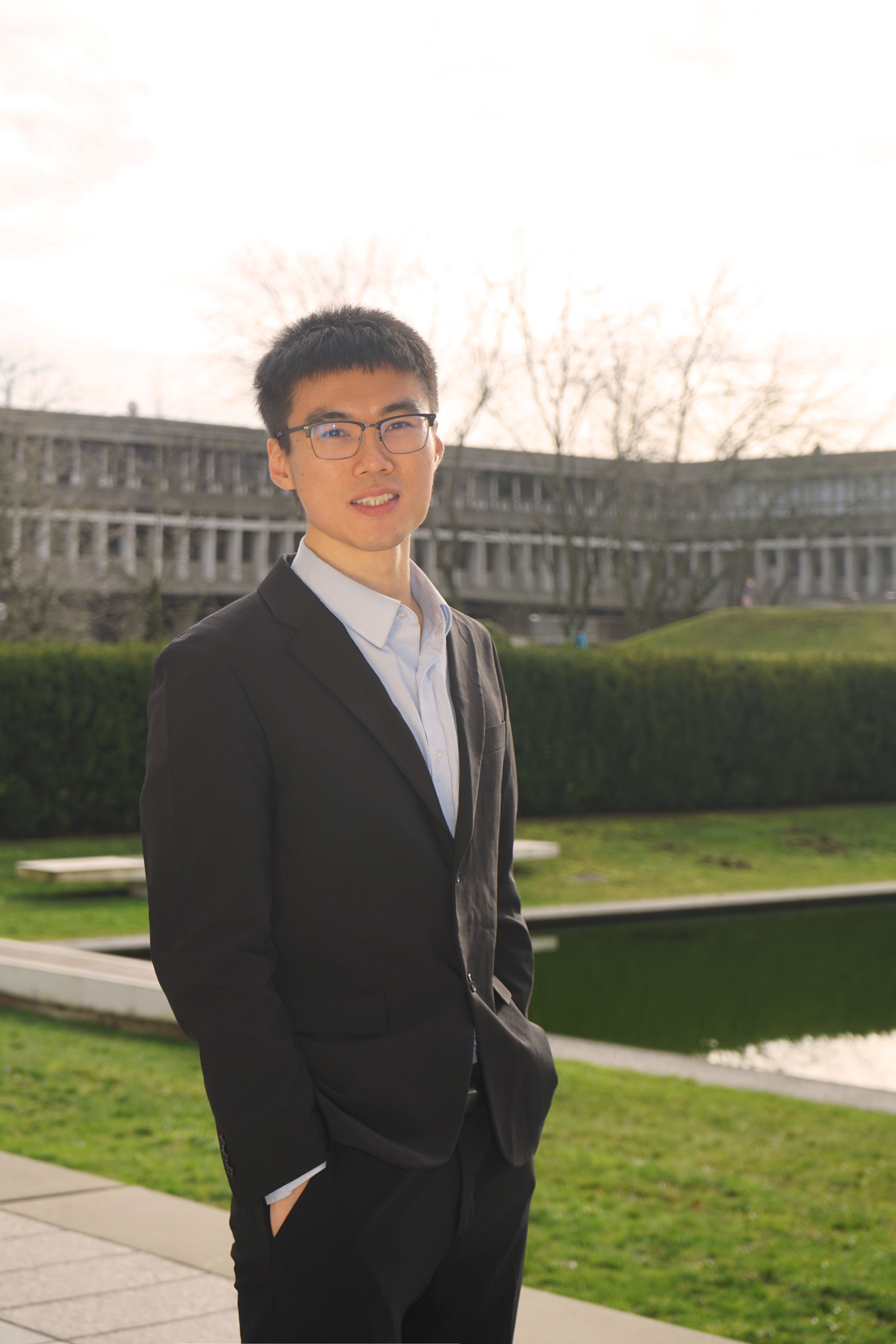
I am a sixth-year Computer Science Ph.D. candidate at Simon Fraser University (SFU), where I also serve as a sessional instructor and Research Assistant. I am advised by Dr. Eugene Fiume, and my research focuses on physically and biomechanically based facial animation. Prior to joining SFU, I earned my Master of Engineering in Electrical and Computer Engineering from Chongqing University in 2020, under the supervision of Dr. Junjie Tang. I am originally from Yichun, Jiangxi Province, China.
Outside of academia, I am an active musician, playing both the piano and clarinet. I used to perform with the SFU Concert Orchestra and the SFU Choir (Tenor 2). I also enjoy staying active through tennis, cycling, and gym, and I love spending my downtime reading classic literature and novels. I am a native Mandarin speaker and fluent in English. In professional and public contexts, I prefer to go by "Richard," though I warmly welcome "Zhiyun" from friends and fellow countrymen.
CV
My Linkedin. My CV. (It's a website CV, not a PDF). My Google scholar website.
Teaching
The courses I have taught:
2026 FALL: Natural Language Processing CMPT 413/713
The course calendar for Natural Language Processing CMPT 413/713
Past courses:
In addition to this classroom experience, I have actively developed and delivered
comprehensive instructional materials online. I created a 26-video lecture series covering
assignment analysis and implementation for Introduction to Computer Graphics, Computer
Animation, and Computer Vision. These videos are hosted on YouTube and Bilibili, where they
have accumulated over 4,600 views, 111 subscriptions, 147 upvotes, and 197 favorites (save),
as of 20260801. An example of my recent teaching material, "Recurrent Neural Network
Stanford CS231N Computer Vision," can be viewed here: https://www.youtube.com/watch?v=AF-s11-a4po, and the
BiliBili version: https://www.bilibili.com/video/BV1UhNM6QEkR/.
My projects
1. Computer graphics, physically and biomechanically based facial animation: Beneath the Skin:
Interactive Biomechanical Facial Simulations via Composable Co-Expressions.
2. Computer graphics, facial animation: Beneath the Skin: Bringing Digital Faces to Life with Intuitive Physics. (A knowledge popularity work targeting audiences outside computer graphics to explain my research). [Video] [Doc] [Submitted, under review]
3. Renewable energy forecasting, machine learning: A novel deep learning ensemble model with data
denoising for short-term wind speed forecasting.
Open Positions: Research Assistant / Developer
Project: Developing an In-House Physical Simulator for Biomechanical Facial & Soft-Tissue Animation
Role: Research Assistant (RA) / Research Software Developer (Funded)
Location: Simon Fraser University (SFU) / Hybrid / Remote-friendly
Supervisor / Mentor: Zhiyun (Richard) Peng (advised by Dr. Eugene Fiume)
We are seeking a motivated and talented Research Assistant / Software Developer to join our research team. With commercial soft-tissue simulation packages (such as Ziva Dynamics) being officially discontinued, our lab is taking the initiative to engineer an independent, high-performance, in-house physical simulator tailored specifically for biomechanical facial animation, and to transition our current Ziva-embedded codebase into this new in-house platform. This project is central to our ongoing research agenda and upcoming post-doctoral research.
Core Research & Engineering Focus:
While general-purpose open-source physics engines exist for rigid bodies or basic cloth, facial animation presents unique biomechanical challenges that standard solvers do not support:
- Soft-Tissue Continuum Mechanics: Formulating stable numerical solvers (e.g., XPBD/PBD, Projective Dynamics, or FEM) incorporating hyperelastic constitutive strain energy models, volume preservation, passive inertia, and gravitational response.
- Anatomical Muscle-to-Skin Coupling (Core Challenge): In facial anatomy, deep actuated muscles interact through subcutaneous fat/fascia to drive the epidermal skin layer. Designing robust mechanical constraints and force-propagation mechanisms connecting muscle activations to epidermal mesh deformations is a foundational focus of this role.
- Collision & Contact Handling: Implementing responsive self-collision detection and contact resolution for multi-layered facial tissues.
- Codebase Transition & System Migration: Helping to transition our current research codebase—which currently relies on an embedded Ziva Dynamics simulation workflow—over to the independent in-house codebase, ensuring existing facial models, rigs, and experimental pipelines run smoothly on the new system.
Modern AI-Assisted Engineering Workflow:
- AI & LLMs Encouraged: We actively encourage the use of State-of-the-Art LLMs (e.g., Claude, GPT-4, Gemini) to accelerate algorithm derivation, translate mathematical models into functional code, and expedite debugging.
- Open-Source Foundations: Existing open-source physical solver architectures can serve as references, which we will adapt and extend to meet the specialized demands of multi-layer biomechanical facial simulation.
Reference Prototype & Context:
As an initial proof-of-concept for interactive visualization, our lab previously developed a lightweight prototype (Interactive Demo Prototype) in collaboration with Silicon Valley startup IdeaVibes. While that prototype is purely kinematic, this opening is a dedicated, serious research and local software engineering position to architect our core physical simulation engine—building the continuum mechanics, hyperelastic strain energy formulations, and anatomical tissue coupling from the ground up.
Desired Qualifications:
- Candidates with a background (or currently pursuing a degree) in Computer Science, Applied Mathematics, Computational Mechanics, or related disciplines.
- Solid programming skills in C++ or Python for local software development and scientific computing.
- Familiarity with or strong enthusiasm for computer graphics, physical simulation (FEM, XPBD/PBD, Mass-Spring), or numerical methods / linear algebra.
- Proactive, self-motivated developer who effectively leverages modern AI coding assistants to solve challenging technical problems.
What We Offer:
- Financial Support: Funded Research Assistantship / Developer stipend.
- Mentorship: Close 1-on-1 research mentorship and hands-on guidance in computer graphics and biomechanics.
- Career & Academic Impact: Clear opportunities for co-authorship on top-tier graphics/biomechanics publications (e.g., ACM SIGGRAPH / SCA), high-visibility portfolio code, and strong recommendation letters for graduate school or industry R&D.
How to Apply:
Interested candidates are warmly invited to email Zhiyun (Richard) Peng at zpa18@sfu.ca with the subject line [RA Application] Physical Simulator - [Your Name]. Please include:
- A brief statement of interest (your background, relevant skills, and why this project interests you).
- Your CV / Resume (and transcript if currently a student or recent graduate).
- A link to your GitHub profile, portfolio, or past code repositories (if available).